Dr. KUSUMA PRAKASH ARAS
Doctor | M.B.B.S | M.D | KMC Regn : 14^^41
JR 1 - Pathology @ AIMS
Part time Fiction Writer | Web Publisher
MBTI ~ INTJ | She / Her - 28 | Born in INDIA
Melophile | Introvert | Misanthrope
DAILY LOG OF JR - 1
I've embarked on the journey to become 'The Pathologist,' with January 1, 2025, marking the start of this endeavor. This section will document my progress daily, sharing the experiences and milestones along the way.


Intriguing Encounters
"Intriguing Encounters" highlights some of the most fascinating and unique cases I've come across in my pathologist journey. Each story is a testament to the complexities and mysteries that make this field so captivating. Join me as I unravel these compelling narratives and share the insights gained from each remarkable case.
Techniques Unveiled
Techniques Unveiled provides an in-depth look at the various techniques and practices used in daily pathology work. From routine procedures to advanced techniques, this section will explore the tools and approaches that pathologists rely on for accurate diagnoses and effective treatment plans. Here you'll find valuable insights into the everyday workings of a pathologist's world.


Thesis Odyssey
A structured log of research progress, breakthroughs, and reflections. This space chronicles the systematic exploration of your selected topic, capturing key milestones, evolving insights, and methodological refinements. Each update marks a step forward, shaping the trajectory of your postgraduate research with clarity and precision.

JR-1's E-LOG

| DATE | POSTING | LOG |
|---|---|---|
| 01/01/2025 | Histopath | It's my first day as a junior resident of pathology. I first met my HOD and reported for duty. Dr. Prajna P Shetty gave me tour of the department and showed me its ins and out. I was assigned to start with histopathology rotation. They showed the grossing room and the technical staffs there. |
| 02/01/2025 | Histopath | Abc |
| 03/01/2025 | Histopath | Abc |
| 04/01/2025 | Histopath | Abc |
| 05/01/2025 | Histopath | Abc |
| 06/01/2025 | Histopath | Abc |
| 07/01/2025 | Histopath | Abc |
| 08/01/2025 | Histopath | Abc |
| 09/01/2025 | Histopath | Abc |
| 10/01/2025 | Histopath | Abc |
| 11/01/2025 | Histopath | Abc |
| 12/01/2025 | Histopath | Abc |
| 13/01/2025 | Histopath | Abc |
| 14/01/2025 | Histopath | Abc |
| 15/01/2025 | Histopath | Abc |
| 16/01/2025 | Histopath | Abc |
| 17/01/2025 | Histopath | Abc |
| 18/01/2025 | Histopath | Abc |
| 19/01/2025 | Histopath | Abc |
| 20/01/2025 | Histopath | Abc |
| 21/01/2025 | Histopath | Abc |
| 22/01/2025 | Histopath | Abc |
| 23/01/2025 | Histopath | Abc |
| 24/01/2025 | Histopath | Abc |
| 25/01/2025 | Histopath | Abc |
| 26/01/2025 | Histopath | Abc |
| 27/01/2025 | Histopath | Abc |
| 28/01/2025 | Histopath | Abc |
| 29/01/2025 | Histopath | Abc |
| 30/01/2025 | Histopath | Abc |
| 31/01/2025 | Histopath | Abc |

| DATE | POSTING | LOG |
|---|---|---|
| 01/02/2025 | Histopath | Abcgdgfghfgdgfgggffhgfdgfhggjjjfggfgdgfdgfjgfkgkhjgfhghjgfhdgsfghgdfhsgfgfhdsgfghhgds fgdsgfgds fdsgdfsgdghsg dgfdgsdfshgfhdsg gfafsjgfgjdsgafgfhgdgshf gfdsgffdhskgffhdjsgfhfgdghsgfg. Dhsgfgdgsfg gdffgdsgfkgshk |
| 02/02/2025 | Histopath | Abc |
| 03/02/2025 | Histopath | Abc |
| 04/02/2025 | Histopath | Abc |
| 05/02/2025 | Histopath | Abc |
| 06/02/2025 | Histopath | Abc |
| 07/02/2025 | Histopath | abc |
| 08/02/2025 | Histopath | Abc |
| 09/02/2025 | Histopath | Abc |
| 10/02/2025 | Histopath | Abc |
| 11/02/2025 | Histopath | Abc |
| 12/02/2025 | Histopath | Abc |
| 13/02/2025 | Histopath | Abc |
| 14/02/2025 | Histopath | Abc |
| 15/02/2025 | Histopath | Abc |
| 16/02/2025 | Histopath | Abc |
| 17/02/2025 | Histopath | Abc |
| 18/02/2025 | Histopath | Abc |
| 19/02/2025 | Histopath | Abc |
| 20/02/2025 | Histopath | Abc |
| 21/02/2025 | Histopath | Abc |
| 22/02/2025 | Histopath | Abc |
| 23/02/2025 | Histopath | Abc |
| 24/02/2025 | Histopath | Abc |
| 25/02/2025 | Histopath | Abc |
| 26/02/2025 | Histopath | Abc |
| 27/02/2025 | Histopath | Abc |
| 28/02/2025 | Histopath | Abc |

| DATE | POSTING | LOG |
|---|---|---|
| 01/02/2025 | Cytopath | Abcgdgfghfgdgfgggffhgfdgfhggjjjfggfgdgfdgfjgfkgkhjgfhghjgfhdgsfghgdfhsgfgfhdsgfghhgds fgdsgfgds fdsgdfsgdghsg dgfdgsdfshgfhdsg gfafsjgfgjdsgafgfhgdgshf gfdsgffdhskgffhdjsgfhfgdghsgfg. Dhsgfgdgsfg gdffgdsgfkgshk |
| 02/02/2025 | Cytopath | Abc |
| 03/02/2025 | Cytopath | Abc |
| 04/02/2025 | Cytopath | Abc |
| 05/02/2025 | Cytopath | Abc |
| 06/02/2025 | Cytopath | Abc |
| 07/02/2025 | Cytopath | abc |
| 08/02/2025 | Cytopath | Abc |
| 09/02/2025 | Cytopath | Abc |
| 10/02/2025 | Cytopath | Abc |
| 11/02/2025 | Cytopath | Abc |
| 12/02/2025 | Cytopath | Abc |
| 13/02/2025 | Cytopath | Abc |
| 14/02/2025 | Cytopath | Abc |
| 15/02/2025 | Cytopath | Abc |
| 16/02/2025 | Cytopath | Abc |
| 17/02/2025 | Cytopath | Abc |
| 18/02/2025 | Cytopath | Abc |
| 19/02/2025 | Cytopath | Abc |
| 20/02/2025 | Cytopath | Abc |
| 21/02/2025 | Cytopath | Abc |
| 22/02/2025 | Cytopath | Abc |
| 23/02/2025 | Cytopath | Abc |
| 24/02/2025 | Cytopath | Abc |
| 25/02/2025 | Cytopath | Abc |
| 26/02/2025 | Cytopath | Abc |
| 27/02/2025 | Cytopath | Abc |
| 28/02/2025 | Cytopath | Abc |
| 29/02/2025 | Cytopath | Abc |
| 30/02/2025 | Cytopath | Abc |
| 31/02/2025 | Cytopath | Abc |

| DATE | POSTING | LOG |
|---|---|---|
| 01/04/2025 | Cytopath | Abcg |
| 02/04/2025 | Cytopath | Abc |
| 03/04/2025 | Cytopath | Abc |
| 04/04/2025 | Cytopath | Abc |
| 05/04/2025 | Cytopath | Abc |
| 06/04/2025 | Cytopath | Abc |
| 07/04/2025 | Cytopath | abc |
| 08/04/2025 | Cytopath | Abc |
| 09/04/2025 | Cytopath | Abc |
| 10/04/2025 | Cytopath | Abc |
| 11/04/2025 | Cytopath | Abc |
| 12/04/2025 | Cytopath | Abc |
| 13/04/2025 | Cytopath | Abc |
| 14/04/2025 | Cytopath | Abc |
| 15/04/2025 | Cytopath | Abc |
| 16/04/2025 | Cytopath | Abc |
| 17/04/2025 | Cytopath | Abc |
| 18/04/2025 | Cytopath | Abc |
| 19/04/2025 | Cytopath | Abc |
| 20/04/2025 | Cytopath | Abc |
| 21/04/2025 | Cytopath | Abc |
| 22/04/2025 | Cytopath | Abc |
| 23/04/2025 | Cytopath | Abc |
| 24/04/2025 | Cytopath | Abc |
| 25/04/2025 | Cytopath | Abc |
| 26/04/2025 | Cytopath | Abc |
| 27/04/2025 | Cytopath | I was assigned for Sunday’s Hemat duty with Dr. Shraddha, we started seeing slides in the morning. There were 5 Peripheral Smears out of which one was NNBP, one was NCHC and rest was McHc Anemia and 2 Retic counts were also there. We also saw a case of high LIC’s in a patient. |
| 28/04/2025 | Cytopath | We started the day with a case of FNAC of Cystic lesion. Later that day we also reported the case of Colloid goitre - TBSRTC Category II. I also had to search for articles about "BCL2 and Ki67 in breast cancer" as I have to get references and input data for my synopsis. |
| 29/04/2025 | Cytopath | Abc |
| 30/04/2025 | Cytopath | Abc |

| Date | Posting | Log |
|---|---|---|
| 01/05/2025 | Hematology | HOLIDAY |
| 02/05/2025 | Hematology | Peripheral smear examination once again took center stage. Today, a dimorphic anemia stood out, highlighting a probable mixed etiology involving iron deficiency and megaloblastic changes. Another case demonstrated normocytic normochromic blood picture with thrombocytopenia, prompting consideration of possible underlying causes, including bone marrow suppression or peripheral destruction. Observing variations in platelet count, as seen in a few cases, reinforced the need for meticulous correlation with clinical findings. |
| 03/05/2025 | Hematology | A relatively steady day with routine smears showing the expected variations in anemia presentations. However, one sample revealed neutrophilic leukocytosis in conjunction with normocytic hypochromic anemia. The presence of increased neutrophils raised concerns about ongoing infection or inflammation. A platelet count performed alongside the smear analysis indicated mild thrombocytopenia in one patient, prompting a discussion on differential diagnoses. |
| 04/05/2025 | Hematology | Slide analysis commenced early in the morning, with the usual mix of normocytic and microcytic anemia cases. One particular smear showed normocytic normochromic blood picture with neutrophilia, a pattern often observed in response to infections or stress. Later in the day, a case requiring a PCV and platelet count emerged, giving an opportunity to correlate hematocrit findings with red cell morphology. |
| 05/05/2025 | Hematology | The morning session included peripheral smear examinations, identifying cases of normocytic hypochromic anemia with thrombocytopenia. This combination often necessitates further investigation into potential bone marrow pathology. A malarial parasite smear was also performed, although no parasitic forms were detected. The sample reinforced the importance of carefully examining blood smears for subtle signs of hemoparasites. |
| - | UG Practicals | Topic : Chronic Pyelonephritis, Renal Cell Carcinoma, Renal Stones. In this session, students learned to distinguish chronic pyelonephritis microscopically, noting interstitial fibrosis and tubular atrophy. The identification of clear cell morphology in renal cell carcinoma reinforced the importance of cytologic features in malignancy. The discussion on renal stones emphasized crystallization patterns and their role in chronic kidney pathology. |
| 06/05/2025 | Hematology | A case of microcytic hypochromic anemia with neutrophilia caught attention today, particularly as neutrophilic changes can indicate acute bacterial infections or other inflammatory triggers. Semen analysis was also conducted, as Tuesdays tend to include this aspect of laboratory work. |
| 07/05/2025 | Hematology | Continuing the routine smear evaluations, today presented dimorphic anemia alongside platelet abnormalities. The platelet count reflected mild thrombocytopenia in one case, emphasizing the need for thorough clinical correlation. CSF analysis was performed for a pediatric case, with findings consistent with mild pleocytosis. |
| - | Journal Club | Topic: Comparative Evaluation of Conventional Smear Method vs. Smear Hub Method Presented by: Dr. Anugraha This discussion emphasized the role of smear preparation in achieving improved diagnostic clarity. The Smear Hub Method, a novel approach, demonstrated enhanced cell distribution and interpretation accuracy compared to conventional techniques. The session reinforced the idea that even small refinements in manual smear methods can significantly improve hematological assessments. |
| 08/05/2025 | Hematology | Peripheral smears continued to dominate the workload, with cases ranging from normocytic anemia to microcytic hypochromic anemia. One sample showed neutrophilic leukocytosis, reinforcing the pattern seen in patients undergoing systemic infections. The observation of varied red cell morphologies kept the analytical process engaging. |
| 09/05/2025 | Hematology | Among today’s cases, a smear revealed microcytic hypochromic anemia with thrombocytopenia, necessitating a deeper understanding of hematological compensation mechanisms. PCV and platelet analysis were also performed, allowing a comparative overview of hematological parameters. |
| 10/05/2025 | Hematology | A steady stream of slides, focusing on normocytic normochromic blood pictures, was observed today. A dimorphic anemia was also identified, prompting considerations of possible nutritional deficiencies contributing to the altered morphology. |
| 11/05/2025 | Hematology | This morning’s session included cases of microcytic hypochromic anemia, along with a notable smear presenting thrombocytopenia. Observing platelet variations remains an ongoing focus, particularly in hematological disorders where subtle morphological details can guide diagnostic interpretation. |
| 12/05/2025 | Hematology | Peripheral smear analysis continued with normocytic hypochromic anemia and neutrophilia appearing prominently in today’s observations. The presence of neutrophilic shifts often requires assessing any underlying inflammatory or infectious triggers. |
| - | UG Practicals | Topic: Osteoclastoma and Osteosarcoma. Students explored the multinucleated giant cells characteristic of osteoclastoma, appreciating its locally aggressive nature. In contrast, osteosarcoma highlighted pleomorphic tumor cells with osteoid production, reinforcing principles of high-grade bone malignancies. Emphasis was placed on distinguishing benign versus malignant bone lesions. |
| 13/05/2025 | Hematology | Today’s examination revealed a dimorphic anemia, reflecting a mixed blood picture typically seen in combined nutritional deficiencies. Discussions centered around the importance of correlating smear findings with biochemical parameters to enhance diagnostic precision. |
| 14/05/2025 | Hematology | Routine smear observations identified microcytic hypochromic anemia with neutrophilic leukocytosis. This case provided an opportunity to examine differentials related to chronic inflammation and how they manifest hematologically. |
| - | Journal Club | Topic: Is Fragmentation of Prostate Core Biopsies Inevitable? A Quality Improvement Initiative Presented by: Dr. Yogitha This session explored the challenges of fragmented prostate biopsies, discussing their impact on histological evaluation and grading accuracy. Strategies for reducing fragmentation included improvements in handling techniques and fixation methods. The discussion emphasized that standardized biopsy processing protocols can lead to better diagnostic precision, reducing ambiguity in malignant and benign prostate pathology. |
| 15/05/2025 | Hematology | A case requiring malarial parasite smear testing was reviewed today, although no parasitic elements were detected. Nevertheless, the process reinforced the significance of meticulous slide examination in cases of suspected hemoparasitic infections. |
| - | Journal Club | Topic: A Cross-Sectional Study on the Spectrum of Clinical Diagnosis in Patients Presenting with Macrocytosis Presented by: Dr. Tejashwini Macrocytosis is commonly associated with megaloblastic anemia, but this session highlighted its broader range of differential diagnoses, including liver dysfunction, hypothyroidism, and myelodysplastic syndromes. The discussion reinforced the importance of integrating peripheral smear findings with biochemical parameters, ensuring a systematic approach to diagnosing patients with macrocytosis. |
| 16/05/2025 | Hematology | Peripheral blood smears exhibited trends consistent with normocytic anemia, with one particular case showing platelet abnormalities that required further analysis through PCV correlation. The approach to thrombocytopenia was again discussed among colleagues. |
| 17/05/2025 | Hematology | Routine slides continued with dimorphic anemia and thrombocytopenia appearing in today’s findings. Observing variations in erythrocyte morphology remains crucial for assessing anemia subtypes comprehensively. |
| 18/05/2025 | Hematology | The day’s observations showed microcytic hypochromic anemia with neutrophilia, aligning with common trends seen in iron-deficiency states and systemic infections. Platelet counts alongside smear analysis allowed for a more integrated assessment. |
| 19/05/2025 | Hematology | Semen analysis was performed today, keeping in line with weekly procedural patterns. Alongside this, cases of normocytic normochromic blood picture were observed, reinforcing typical patterns seen in hematology practice. |
| - | UG Practicals | Topic: Seminoma, BPH, Carcinoma Penis. The students identified large, clear cells with prominent nucleoli in seminoma, deepening their understanding of germ cell tumors. The classic histological features of benign prostatic hyperplasia (BPH)—glandular hyperplasia and stromal expansion—were compared with squamous cell carcinoma of the penis, which displayed dysplastic epithelial changes. |
| 20/05/2025 | Hematology | A pediatric CSF analysis took place today, with findings supporting mild pleocytosis. Peripheral smear analysis continued, identifying anemia cases requiring further correlation with patient history. |
| 21/05/2025 | Hematology | Cases of normocytic hypochromic anemia alongside thrombocytopenia dominated today’s observations. Assessing platelet trends continues to be an essential aspect of hematological evaluations. |
| - | Journal Club | Topic: Determination of Microvessel Density by CD34 Immunoreactivity in Female Breast Cancer and Its Relation to Grading and Staging Presented by: Dr. Ganashree Tumor angiogenesis plays a critical role in cancer progression, and microvessel density (MVD) assessment using CD34 immunohistochemistry provides insight into the biological behavior of breast cancer. The session reinforced how MVD correlates with tumor staging and aggressiveness, aiding in prognostic evaluation and therapeutic planning. |
| 22/05/2025 | Hematology | Neutrophilic leukocytosis was noted in a smear examined today, prompting deeper assessment into possible reactive causes. Platelet assessments further contributed to refining the hematological picture. |
| - | Seminar | Topic: Tissue Processing Part 1 (Introduction, Fixation, Dehydration, Clearing) Presented by: Dr. Sahana This seminar covered the fundamentals of tissue processing, explaining how fixation maintains structural integrity, dehydration prevents tissue distortion, and clearing prepares samples for paraffin embedding. The session reinforced that each step plays a crucial role in producing high-quality histological sections, ensuring clarity and diagnostic accuracy. |
| 23/05/2025 | Hematology | Routine smear analysis identified dimorphic anemia, reinforcing trends of combined deficiency states requiring close biochemical correlation. Discussions revolved around optimizing diagnostic specificity. |
| 24/05/2025 | Hematology | Peripheral smear observations remained steady today, with microcytic anemia continuing to be a prevalent finding. Identifying subtleties in red cell morphology ensured thorough assessment of hematological parameters. |
| 25/05/2025 | Hematology | The day began with routine slide analysis, primarily focusing on cases of normocytic normochromic blood picture with neutrophilia. The increased neutrophil count prompted discussions on possible reactive causes, including infections or inflammatory states. Additionally, a peripheral smear showing microcytic hypochromic anemia with mild thrombocytopenia was examined, reinforcing the need for correlating hematological findings with clinical history. |
| 26/05/2025 | Hematology | Peripheral smear reviews included normocytic hypochromic anemia with neutrophilic leukocytosis, indicating a possible underlying systemic infection. A dimorphic anemia case also surfaced, displaying clear morphological variations in erythrocytes, likely stemming from nutritional deficiencies. Today also involved platelet analysis, confirming mild thrombocytopenia in a few samples. |
| - | UG Practicals | Topic: Leiomyoma Uterus, Hydatidiform Mole. The whorled smooth muscle bundles in leiomyoma served as a clear example of benign uterine tumors, contrasted against the hydropic villi and trophoblastic proliferation seen in hydatidiform mole. The discussion centered on differentiating benign gestational pathology from aggressive trophoblastic disorders. |
| 27/05/2025 | Hematology | Smear examinations continued with observations of microcytic hypochromic anemia, a frequently encountered hematological condition. One case presented normocytic normochromic blood picture with thrombocytopenia, emphasizing the importance of platelet assessment in hematological evaluations. Additionally, semen analysis was conducted, consistent with the weekly laboratory procedures. |
| 28/05/2025 | Hematology | Today’s smears revealed expected anemia patterns, primarily microcytic hypochromic and normocytic normochromic cases. One sample demonstrated neutrophilic leukocytosis alongside normocytic hypochromic anemia, suggesting an acute response to infection. Platelet counts performed alongside the smear analysis provided further insight into hematological consistency among cases. |
| - | Journal Club | Topic: Nipple Adenoma: A Clinicopathological Study Over a Period of Six Years in a Tertiary Care Center Presented by: Dr. Prajna P Shetty. This journal club explored nipple adenoma, a benign condition often confused with malignancies like Paget’s disease and ductal carcinoma in situ (DCIS). The discussion emphasized recognizing architectural patterns and the importance of immunohistochemical markers to distinguish nipple adenoma from other lesions, preventing misdiagnosis and unnecessary treatment. |
| 29/05/2025 | Hematology | A pediatric CSF analysis was performed today, yielding findings of mild pleocytosis. Peripheral smear evaluations identified normocytic hypochromic anemia alongside thrombocytopenia, reinforcing ongoing trends in hematology observations. A discussion on correlating smear findings with biochemical assessments ensued, ensuring an integrated diagnostic approach. |
| 30/05/2025 | Hematology | Routine slide analysis involved cases of normocytic normochromic blood picture and mild thrombocytopenia. One notable sample displayed neutrophilic leukocytosis, prompting further evaluation of potential infectious etiologies. Conversations revolved around ensuring clinical correlation with hematological variations observed under microscopy. |
| 31/05/2025 | Hematology | Closing the month with routine smear evaluations, cases of microcytic hypochromic anemia remained prevalent. A dimorphic anemia was observed, reinforcing nutritional deficiency concerns. Additionally, platelet assessments were reviewed for continuity in hematological interpretations. The discussions today centered on refining diagnostic precision through structured smear analysis. |
| - | Seminar | Topic: Tissue Processing Part 2 (Infiltration, Embedding, Sectioning, Staining, Mounting) Presented by: Dr. Kusuma P (Me!) This seminar, led by me, delved into the final steps of tissue processing that ensure histological precision. The discussion emphasized infiltration for proper wax penetration, embedding techniques for structural integrity, and sectioning methods to minimize artifacts. Staining protocols were explored to highlight tissue morphology, reinforcing that each processing step contributes to the diagnostic quality of histopathology slides. |

| DATE | POSTING | LOG |
|---|---|---|
| 01/06/2025 | Hematology | Abcg |
| 02/06/2025 | Hematology | Abcg |
| 03/06/2025 | Hematology | Abcg |
| 04/06/2025 | Hematology | Abcg |
| 05/06/2025 | Hematology | Abcg |
| - | Journal club | abc |
Intriguing Encounters
abcc
Techniques Unveiled

abc
abc
abc
Thesis Odyssey
| DATE | LOG |
|---|---|
| 03/04/2025 | I had my first meeting with my guide, Dr. Abhishek M G. He introduced the dissertation process and asked us to decide on a specific field for our research. The options included histopathology, hematology, cytology, forensic pathology, immunohistochemistry (IHC), and molecular pathology. This was the starting point of my journey, where I needed to define the direction I wanted to take for the next few years. |
| 10/04/2025 | I met with Dr. Abhishek again, having given some thought to my interests. I was inclined toward IHC and Molecular Medicine, as these fields fascinated me. He encouraged me to consider cancers we frequently encounter in histopathology, suggesting breast cancer, thyroid cancer, and other malignancies. His advice helped me narrow my focus, pushing me to explore topics that were both clinically significant and feasible. |
| 14/04/2025 | I had done some background research and decided to pursue Papillary Thyroid Carcinoma, specifically the role of molecular and IHC markers in its diagnosis and prognosis. I was eager to delve into how these markers could aid in better understanding the disease and improve treatment strategies. |
| 16/04/2025 | I presented my chosen topic to Dr. Abhishek. He carefully reviewed my proposal and pointed out a few concerns. First, he explained that IHC in papillary thyroid carcinoma wouldn’t significantly impact treatment strategies, making it less meaningful in clinical practice. Second, he highlighted the financial constraints of molecular miRNA analysis, which would make my study costly and difficult to execute. Based on these limitations, he advised me to shift my focus toward IHC markers in breast cancer, which had clearer clinical implications. |
| 17/04/2025 | after careful reconsideration, I finalized my dissertation topic: Association of BCL2 and Ki67 in Breast Cancer. It was an important moment as I realized how impactful these markers were in understanding tumor progression and prognosis. With this refined focus, I was ready to move forward with literature review and research planning. |
| 27/04/2025 | my guide instructed me to start searching for references that would support my synopsis. He asked me to find five original research articles, two books, and two credible websites that would serve as key sources for my study. This task required a deep dive into published literature to ensure that my research would be well-founded. |
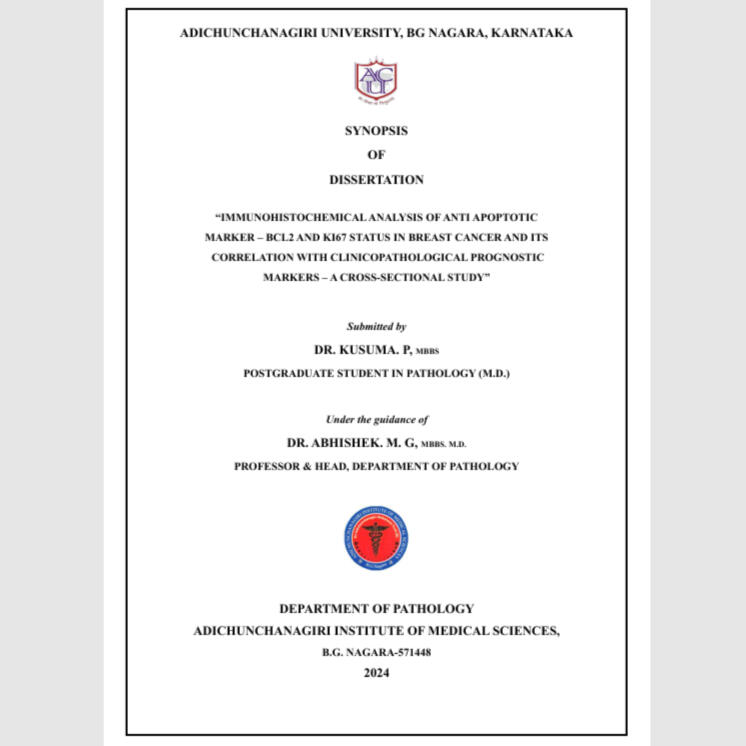
| 06/05/2025 | I had carefully selected and reviewed all the necessary references. I met with Dr. Abhishek to discuss them, and he approved my selections. With this confirmation, I was ready to begin drafting my synopsis. During this discussion, we also finalized the title of my dissertation: "IMMUNOHISTOCHEMICAL ANALYSIS OF ANTI-APOPTOTIC MARKER – BCL2 AND KI67 STATUS IN BREAST CANCER AND ITS CORRELATION WITH CLINICOPATHOLOGICAL PROGNOSTIC MARKERS – A CROSS-SECTIONAL STUDY." Having a definitive title gave my research a clear direction, and I felt a strong sense of progress. |
| 13/05/2025 | I submitted the first draft of my synopsis to Dr. Abhishek for review. I was eager to receive feedback, knowing that revisions would be necessary to refine and strengthen my work. |
| 17/05/2025 | my guide approved and signed the Ethical Clearance Proforma, allowing me to move forward with the Institutional Ethics Committee (IEC) application for research approval. The ethical clearance process was a crucial step before proceeding with data collection. |
| 19/05/2025 | after incorporating some minor edits based on my guide’s feedback, I submitted the revised version of my synopsis for another round of review. Each refinement brought more clarity and rigor to my proposal. |
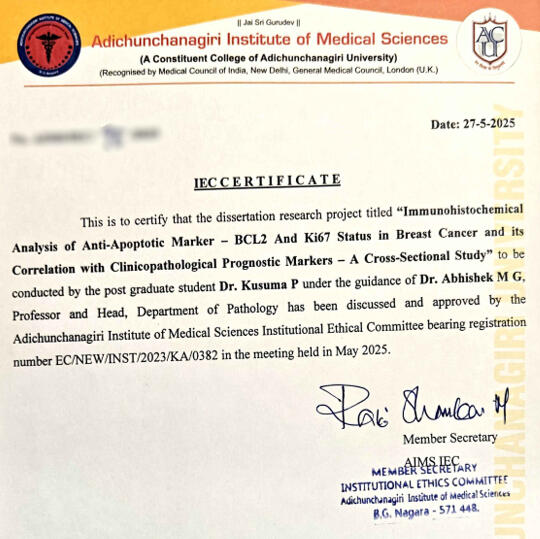
| 27/05/2025 | the IEC screening process was successfully completed. To my relief, the clearance was granted without any corrections, affirming that my study met ethical standards. This was a major milestone, ensuring that I could officially proceed with my research. |
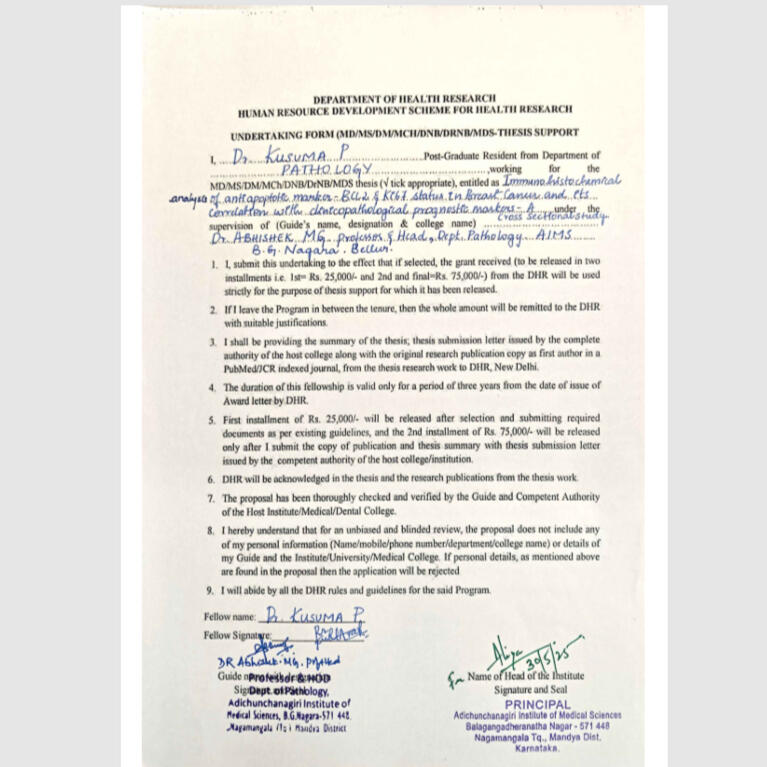
| 31/05/2025 | I received my IEC certificate of ethical clearance, marking the formal approval of my study. With this certificate in hand, I submitted my research proposal to the Department of Health Research (DHR) for MD thesis support grants. Getting this funding was essential for ensuring the feasibility of my research. |
| 05/06/2025 | I had another meeting with Dr. Abhishek to discuss any necessary refinements in the current version of my synopsis. With the university submission deadline of 20/06/2025 fast approaching, I wanted to ensure that every detail was polished to perfection. This final stage was about fine-tuning my work, making sure that my research proposal was clear, structured, and met all institutional requirements. Now, as I approach the submission deadline, I feel a mix of excitement and determination. Each step in this journey has shaped my understanding of research, and I am eager to see how my study unfolds in the coming months. |
ARCHIVES OF DOCUMENTS

DHR - Guide Undertaking

Ethical Clearance

Cover Page